Get in touch
I'm always excited to take on new projects and collaborate with innovative minds.
Phone
Website
Address
Dhaka, bangladesh
I'm always excited to take on new projects and collaborate with innovative minds.
Dhaka, bangladesh
Returns are part of online selling. Learn how to write a fair return policy, handle refund requests smoothly and turn a return into a repeat customer.
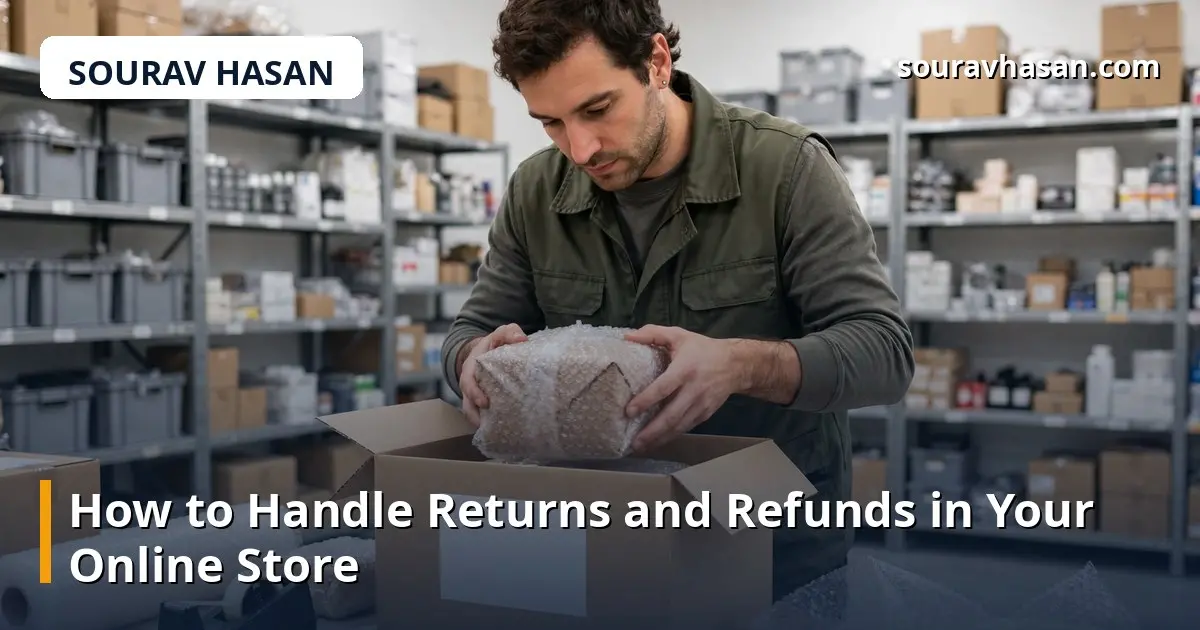
Every online store gets returns. A customer orders the wrong size, a product arrives damaged, or something simply does not match what they expected from the photos. How you handle that moment matters more than the sale itself — a smooth return often creates a loyal customer, while a difficult one loses that customer for good and earns you a public complaint.
I run an e-commerce store in Dhaka, and returns are a normal part of my week. Over time I have learned that the stores that handle returns well are not the ones with the most generous policies — they are the ones with the clearest process. This guide covers how to write a fair policy, run a smooth returns process, and turn an unhappy buyer into someone who orders again.
Many small sellers treat returns as a loss to avoid. That is the wrong way to look at it. A clear, fair return policy actually increases sales: shoppers are far more likely to order when they know they can send something back if it does not work out. It is the online equivalent of letting a customer hold the product in a shop before deciding.
Returns also tell you something valuable about your business. If the same product keeps coming back, the listing may be misleading — the photos, the size chart or the description may be setting the wrong expectation. Track the reasons for returns and you will find product page improvements hiding in plain sight. My guide on reducing cart abandonment covers the same principle from the other side: trust is what turns a hesitant visitor into a buyer.
Before your first return request arrives, write the policy down and publish it where customers can find it — a link in the footer and on the checkout page at minimum. A good policy answers five questions plainly:
Keep the language simple. A policy written in plain words that a customer can understand in one reading is worth far more than a long legal document nobody reads.
When a customer asks to return something, the process should feel easy, not like a negotiation. Here is a routine that works well for a small store:
Most refund conversations go badly because the seller sounds defensive. Remember that the customer is not attacking you — they spent money and the product did not work out. A calm, helpful tone costs nothing and usually ends the conversation in one or two messages.
Avoid asking the customer to prove themselves repeatedly. One photo and the order number are enough to start. Avoid blaming the courier or the supplier in your reply; the customer bought from you, and it is your responsibility to make it right, even if you later recover the cost from someone else. And never make the customer chase you — if you said the refund will arrive in five working days, send it in five working days.
Not every return is a loss. Sort returned items into three groups as soon as they arrive. Items in perfect condition with intact packaging can go straight back into stock. Items with damaged packaging but a working product can be sold as open-box at a small discount, clearly described as such. Items that are faulty should be set aside for warranty or supplier return — never resold as new.
Keep returned stock physically separate from new stock until it is inspected, and mark it in your inventory system so you never accidentally ship a returned item to another customer as new. This is part of the daily discipline of running a store, which I covered in my guide on managing an OpenCart store day to day.
Here is the part most sellers miss: a customer who had a problem that you fixed well is often more loyal than a customer who never had a problem at all. They have seen how you behave when things go wrong, and that builds more trust than any advertisement.
After the refund is complete, follow up once — a short message thanking them and, where appropriate, offering a small discount on their next order or help choosing a replacement product. Do not be pushy about it. The goal is simply to show that the relationship matters more to you than the single transaction. Many of my own repeat customers started with a return.
Free returns for faulty or wrong items, yes — that is your responsibility. Free returns for change of mind is a business decision: it can increase sales, but it also increases costs. Many small stores split the difference by covering the return delivery only when the fault is theirs.
Seven days from delivery is a common and fair standard for small stores in Bangladesh. Longer windows can build trust, but they also leave stock in limbo. Whatever you choose, state it clearly and apply it consistently.
Your policy should cover this before it happens. State that items must be unused and in original packaging for a full refund, and that used or damaged items may receive a partial refund or be declined. Inspect every return before deciding.
Yes, when the request falls outside your published policy — for example, after the window has closed, or for a personalised item you stated was non-returnable. Refuse politely, explain the reason, and offer an alternative where you can, such as a repair or an exchange.
Returns feel like a cost, but handled well they are one of the cheapest ways to build trust. Write the policy before you need it, answer requests the same day, refund on time, and learn from every return. Customers remember how a store treats them when something goes wrong far longer than they remember the price. Get returns right and they stop being a problem — they become a reason customers come back.
Your email address will not be published. Required fields are marked *